

Today, public bike repair stations are a familiar sight on college campuses, trails, transit hubs, and city streets around the world. But when the Fixit first appeared, the concept was almost unheard of.
The original inspiration came from an unlikely source: ski resorts. While visiting a ski hill, Rolf Scholtz noticed self-service maintenance stations equipped with tethered screwdrivers and basic tools for adjusting ski bindings. Why, he wondered, didn’t something similar exist for bicycles?
When presented with the concept, Dero’s engineer, Joel remembered another form of public bicycle maintenance at Varsity Bike & Transit in Minneapolis’ Dinkytown neighborhood. The bike shop had placed a simple cinder block with bike tools attached by cables which cyclists could use to make quick repairs (and eventually stop into the shop when they got out over their skis). The overall vision came together when Joel suggested it would be really helpful to add a way to elevate a bicycle by its saddle for repairs.
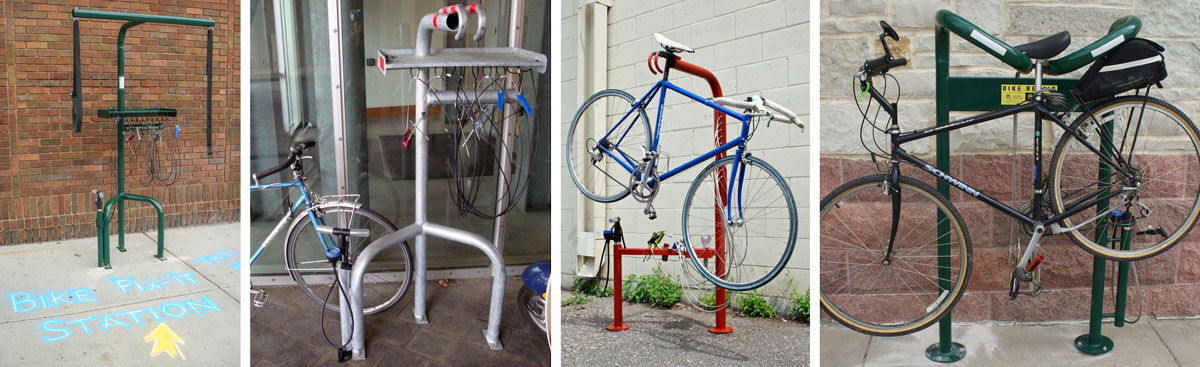
Much like the early days of aviation, the earliest designs were, well…ambitious. Some included hooks, straps, and trays, in various forms and configurations. They worked, but they were large, complicated, and difficult to manufacture and ship. The first units to be installed taught valuable lessons about overall usability and safety. Over time the team refined the design down toward a cleaner cylindrical form that was stronger, easier to manufacture, and significantly less expensive to transport. An unexpected opportunity to repurpose material came from finding readily available leftover industrial tubes originally used in packaging production, which became the basis for many of the early round-column stations.
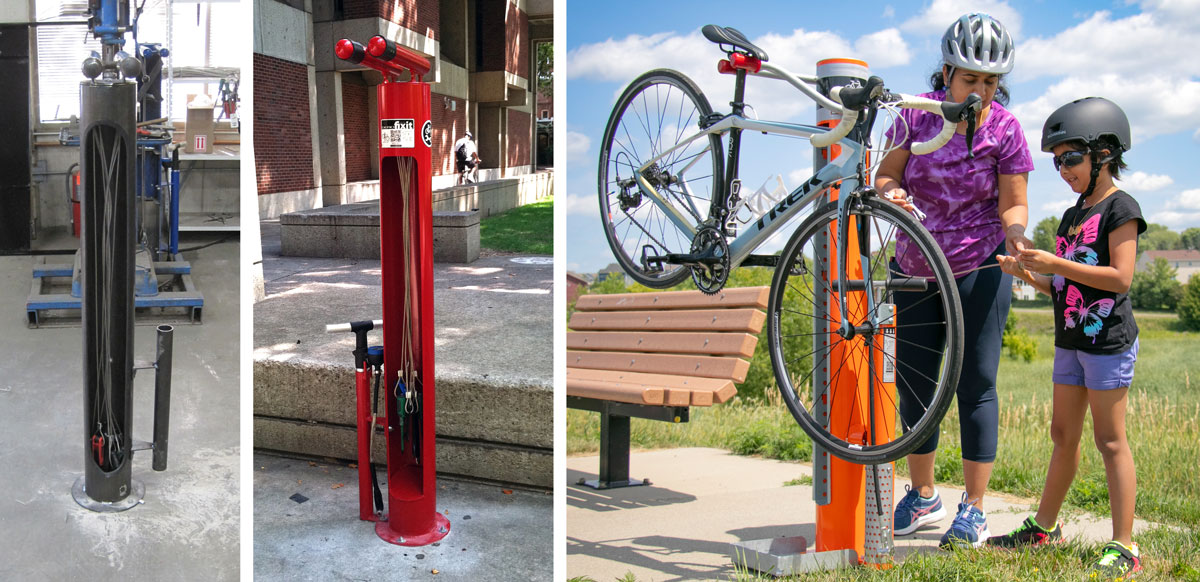
Unlike many new products that require years of market education, the response to the Fixit was almost immediate. Universities were among the earliest adopters, and customers quickly recognized the value of providing cyclists with free access to repair tools and air. According to Rolf Scholtz, it was one of the first products the company ever introduced that generated an instant reaction of, “That’s a great idea. We need that.”
Today, repair stations can be found throughout North America and beyond. The concept has inspired countless imitators, but the original Fixit continues to evolve through improvements such as proprietary pumps, purpose-built tools, and the latest Fixit Plus platform. What began as an observation at a ski hill and a cinder block outside a bike shop grew into a category-defining product that helped make cycling more accessible for riders everywhere.